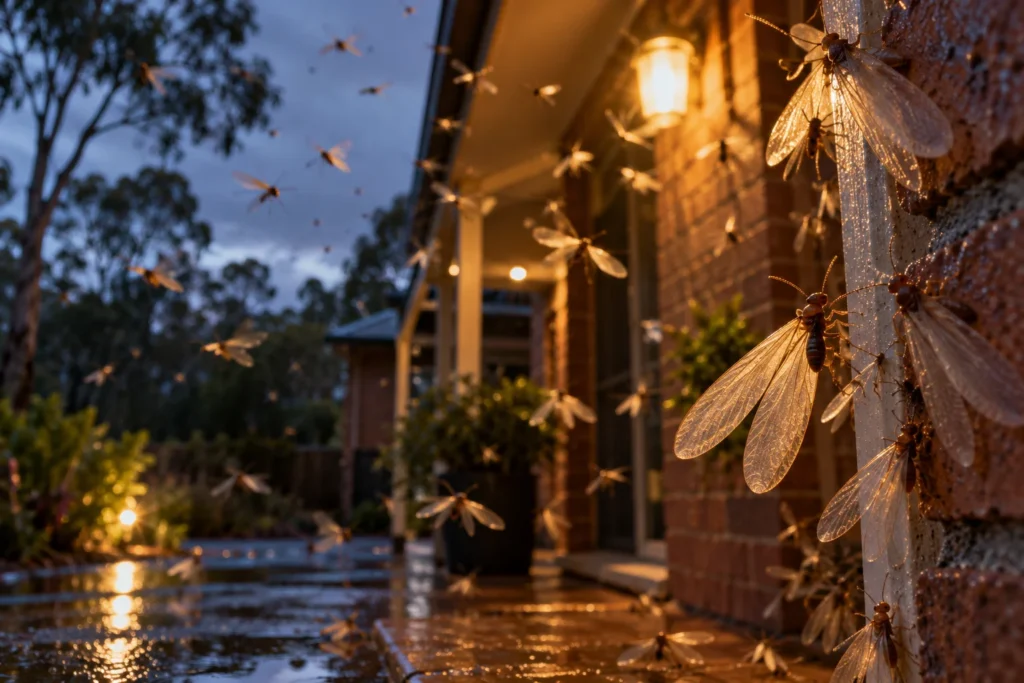
Termite swarm season in Australia commonly brings flying termites during warm, humid weather, often in spring and summer. There is no single national start or finish date: species, local climate and weather conditions influence the timing, and some flights occur in autumn or during northern wet-season conditions. Identify the insects, record where they appeared and arrange an assessment if you suspect activity in your property.
A cloud of winged insects around a light can be surprising, especially when loose wings appear indoors the following morning. The important questions are what the insects are, where they came from and whether the building contains other termite evidence. The month alone cannot answer those questions.
This guide explains seasonal patterns, reproductive flights and the difference between an outdoor sighting and evidence needing closer investigation. For Melbourne properties, our termite inspection and treatment service connects those observations with a property assessment and appropriate management advice.
When Is Termite Swarm Season in Australia
Spring and summer are useful periods for heightened awareness, but a fixed September-to-December rule does not cover every Australian termite flight. Even nearby properties can experience different sightings because the species, colony and local conditions differ.
The calendar below describes seasons and how to interpret them. It is an awareness guide rather than a forecast for a particular colony or a promise that termites stop outside these months.
| Australian season | Months | How to interpret the timing |
| Spring | September to November | Warming conditions can coincide with reproductive flights; local weather still matters. |
| Summer | December to February | Warm, humid conditions can support flights, including in regions with summer rain. |
| Autumn | March to May | Some species or locations can have flights; a spring-only rule is incomplete. |
| Winter | June to August | A lack of visible swarming does not establish that a property is free of termites. |
General educational accounts emphasise different seasons because they describe different termite groups and settings. Australian university guidance discusses warm, humid spring or summer evenings, while museum information also recognises autumn flights. These descriptions support a flexible seasonal understanding.
For a homeowner, the practical rule is to take an identifiable termite sighting seriously whenever it occurs. Use the season as background information, then assess the actual evidence and property conditions.
Why Termites Swarm and What Alates Do
Flying termites are reproductive members of a colony, commonly called alates or swarmers. Their role is to leave an established colony, find a partner and attempt to start another colony. Workers and soldiers perform different tasks and are not the insects taking a reproductive flight.
After landing, surviving reproductive termites shed their wings and look for a suitable place to establish themselves. Successful pairs can become the king and queen of a new colony. Many individuals do not survive or establish a nest, so a visible swarm does not mean every insect will create a damaging colony.
The University of the Sunshine Coast’s educational explanation of termite swarming describes alates and their warm-weather reproductive flights. This biology explains why loose wings can remain after the flying insects have disappeared.
A swarm is evidence of a reproductive event, not a direct measurement of timber damage. The source colony might be associated with a tree, soil or another nesting location. Whether the building is affected needs separate investigation.
This distinction matters when responding. Removing visible flying insects may deal with a nuisance, but it does not establish the condition of concealed timber or resolve an existing infestation. An inspection considers the building and supporting evidence alongside the sighting.
How Swarming Patterns Differ Across Australia
Australia’s climate and termite diversity make one national flight calendar unreliable. Regional descriptions can help you understand the setting, but the actual species and local weather determine how useful those descriptions are for your property.
Melbourne and temperate southern areas
For Melbourne homeowners, spring and summer provide a practical period to watch for flying termites and discarded wings as the weather warms. A suitable humid evening can be more informative than the first day of a particular month.
Cool weather between warmer days does not establish that an existing colony has stopped feeding. Record sightings when they occur, and keep routine inspection arrangements based on the property rather than waiting for a seasonal swarm.
Queensland and the subtropical east
Queensland public guidance has described substantial swarming in November and December, with the season continuing into March. This illustrates why an early-summer description can extend beyond a narrow spring window.
That guidance is a broad regional account, not a forecast for every Queensland suburb or termite species. Humidity, rainfall and local conditions still need consideration. A summer sighting deserves the same identification and property assessment as one recorded in spring.
The tropical north
Northern Territory educational material associates reproductive activity with wetter months from November to March and explains that alates prepare before the wet season. A wet-season context is therefore useful when discussing northern flights.
Avoid applying that description as an exact timetable for the whole of northern Australia. Species and conditions differ across the region. The observation at your building remains more useful than assuming that a swarm must follow the same timing as another location.
Other locations and local exceptions
A timing guide for Sydney, Brisbane or Melbourne should not automatically be transferred to Perth, an inland town or a different climate zone. Coastal humidity, local rainfall and termite species can affect the conditions experienced at a site.
If an insect sighting falls outside a commonly advertised season, seek identification rather than dismissing it. A calendar cannot establish whether the insects are termites, whether they emerged locally or whether the building has concealed activity.

Weather Conditions That Can Influence a Flight
Warmth and humidity recur in descriptions of termite reproductive flights. Rain can coincide with suitable conditions, while the timing of a flight still depends on the termite species and colony. A weather event does not guarantee a swarm at every nearby property.
Warm conditions
Rising temperatures can help create suitable flight conditions, particularly after cooler periods. However, a single temperature threshold is not a reliable rule for all Australian termites.
Record what happened rather than trying to diagnose a flight from a thermometer reading. The date, location and visible insects give an inspector more useful starting information than an assumed universal trigger.
Humidity and rain
Humid conditions are often associated with swarming, and sightings may occur around a period of rain. Rainfall can also draw attention to drainage, leaks or other property moisture problems that deserve maintenance.
The two issues need to be understood separately. Rain can be relevant to flight conditions, while a damp area may affect the building. Neither observation, by itself, confirms an infestation or shows how much timber is affected.
Evening conditions and lighting
Many flights are noticed in the evening, and some swarmers gather around lights. A porch light or illuminated window can therefore be where you first notice insects, even when their original source is elsewhere.
Not all flights follow an identical time of day. Do not rule out termites solely because you noticed insects in daylight. Identification should rely on the insect and evidence, rather than the clock alone.
Conditions can change quickly
A quiet evening followed by a sudden flight can make the event appear unexpected. It does not mean the colony developed overnight. Similarly, a swarm disappearing by morning does not establish that the property is clear.
Keep a brief record of sightings and any nearby building concerns. This helps connect a short-lived event with the longer assessment and management of the property.
Flying Termites or Flying Ants
Ants also have winged reproductive forms, so a seasonal insect cloud is not automatically a termite swarm. A few visible features can help an initial comparison, although photographs and damaged specimens may not show them clearly.
| Feature | Winged termites | Winged ants |
| Waist | Broad, without a strongly pinched middle | A more clearly pinched waist |
| Antennae | Relatively straight, with bead-like segments | Usually elbowed |
| Wings | Two pairs of broadly similar size | Front wings larger than the rear pair |
| Colour | Can be darker than pale termite workers | Varies by species; colour alone is insufficient |
| Interpretation | Needs termite identification and a property assessment when relevant | Needs ant identification and a response suited to the setting |
Avoid relying on colour alone. People often expect every termite to look like a pale worker, but reproductive termites can look different. The combined body shape, antennae and wings are more useful than a single colour impression.
Photograph an insect clearly if you can do so safely. A close view with the body and wings visible helps, while a photograph showing where the insects gathered provides context. A blurred image of a cloud around a lamp may not establish the species.
If identification remains uncertain, describe the observation as suspected flying termites. Tell the provider where they appeared and whether there were loose wings or other evidence. Correct identification prevents an unrelated treatment from being selected simply because the insects were called ants.
What an Outdoor Swarm Near Your Home Means
An outdoor termite swarm indicates reproductive termite activity in the surrounding area. It does not automatically confirm that the insects came from the building or that its structural timber is damaged. The source and relevance to the property need assessment.
For example, insects seen around a veranda light may have flown towards that light. If you also see them emerging from a specific surface, that observation is more useful than their final gathering place. Record the location without opening the material or disturbing suspected workings.
Look for other accessible evidence during ordinary property care. Earthen tracks, damaged timber or a persistent moisture concern can provide additional context. Their absence during a quick look does not establish that concealed spaces are clear.
The response should reflect the evidence. A confirmed termite sighting is a reason to discuss an inspection, while visibly damaged or unstable material can also require a building assessment. Counting the insects cannot tell you how much timber is affected.
Do not try to locate and destroy every nest in the garden. Termite species and nesting habits differ, and not every outdoor species is a structural pest. Explain what you observed and let the assessment determine which findings matter for protecting the property.
What Indoor Swarmers and Discarded Wings Can Tell You
Indoor sightings need careful attention because the insects may have entered through an opening or emerged from an area associated with the building. These possibilities have different implications, and the gathering point alone may not reveal which occurred.
Note whether doors or windows were open, where the first insects appeared and whether they seemed to emerge from a particular joint or surface. Seeing insects at a window can indicate that they are gathering near light or trying to leave; it does not identify the original source by itself.
Loose wings can remain on a sill, floor or near a light fitting after the event. Photograph their distribution before cleaning. Ask the inspector what evidence should be retained and how to handle the area while waiting for the visit.
Our termite detection and assessment service examines accessible evidence and property conditions to help establish what the sighting means. Tell us about repeated appearances or suspected emergence from building material.
A concentrated indoor sighting, particularly alongside other termite evidence, should be assessed promptly. Avoid opening wall linings or removing skirting boards to investigate it yourself. Preserve the relationship between the visible evidence and surrounding material so the inspection has useful context.
What to Do If You Find Flying Termites
Begin with identification and a record of the event. A few clear observations are more useful than repeated spraying or trying to expose concealed areas before an inspector arrives.
- Photograph the insects, wings and the area where they first appeared.
- Record the date, approximate time and whether the sighting was indoors or outside.
- Note any apparent emergence point without touching or opening it.
- Leave suspected mud tubes and affected building material undisturbed.
- Avoid household surface sprays on suspected termite workings.
- Contact a termite professional and explain the evidence and access arrangements.
If you have already cleaned, sprayed or removed something, tell the inspector what you did and where. This helps them interpret the remaining evidence. There is no benefit in withholding earlier actions because the original conditions may have changed.
Closing doors or windows and maintaining screens can reduce insects entering during an outdoor flight. Adjusting unnecessary lighting may also reduce a gathering nuisance. These measures do not treat a termite colony or replace a property assessment.
For a rental, shared building or business, notify the person responsible for access and maintenance. Describe the location clearly so the relevant areas can be included. If the discovery occurred during renovation, pause work around suspected workings until the next step is agreed.
Why a Swarm Can Stop While Termite Activity Continues
Swarming is a reproductive event. It is different from workers feeding, maintaining tunnels and supporting an established colony. A short period of flying activity therefore cannot be used as the timetable for all termite activity at a property.
When the insects disappear, there are still questions to answer about identification, source and building evidence. The lack of another visible flight does not show that a colony has died, that treatment succeeded or that concealed timber is undamaged.
The same applies outside a commonly discussed season. Waiting until next spring can leave an existing property concern unassessed. Use current evidence and inspection findings to decide the next step rather than assuming the calendar has removed the risk.
Keep earlier reports and treatment records available. In Victoria, public building guidance recommends inspections every 12 months, especially in higher-hazard areas. Our annual termite inspections in Melbourne offer a way to review accessible findings and changes at the property.
The appropriate monitoring and inspection arrangements depend on the site and any installed system. Ask which checks are scheduled, what they cover and what new evidence should trigger earlier contact. Routine appointments and an assessment of a new sighting can serve different purposes.
How Inspection and Termite Management Work
A useful service begins by considering the reported insects alongside accessible building evidence. The management plan should follow the findings, termite identification, construction and access. A swarm alone does not select the treatment method.
Inspection and reporting
Tell the inspector where and when the insects appeared, whether any seemed to emerge from building material and which doors or windows were open. Supply photographs and previous records, and make requested areas accessible.
An inspection may cover accessible internal and external areas, relevant timber, roof spaces or subfloors within the agreed scope. Concealed and inaccessible areas can limit the findings. Ask what was inspected, what remains uncertain and whether further investigation is recommended.
If you are purchasing a property, a pre-purchase pest inspection in Melbourne can assess accessible timber-pest concerns. A recent swarm is useful background to report, but the inspection should consider the property more broadly. Coordinate any structural questions with a building professional.
Baiting and monitoring systems
Termite baiting and monitoring systems can be appropriate within a property-specific plan. Monitoring helps assess activity, while suitable baits are used according to the selected system and findings.
Ask who services the stations, how findings are recorded and what happens when termites are detected. Ongoing checks matter. An installed station does not establish that every part of a building is clear or that future inspection is unnecessary.
Soil treatments and reticulation
Chemical soil barriers involve an appropriate treatment applied to suitable soil zones. Building design, access and site conditions influence the proposed work and its limitations.
Termite reticulation systems use installed pipework to distribute suitable treatment when the system and property allow it. Existing systems need identification and assessment rather than an assumption that every pipe installation can be replenished.
Follow-up and property work
Request an explanation of preparation, precautions, reporting and follow-up for the proposed service. The expected response depends on the findings and method; the end of a visible swarm is not a treatment result.
Where timber is damaged, pest management and structural repair need separate consideration. Agree who assesses the components and how repairs will be coordinated with treatment access. Keep the report so future inspections have a clear record of the findings and work.
Preparing Your Property Before Warmer Weather
Seasonal preparation focuses on access, moisture and maintaining the property’s termite management arrangements. These actions are useful property care, but they do not establish that an existing infestation has been treated.
- Repair leaks and investigate recurring damp areas.
- Maintain drainage and address water collecting near the building.
- Keep existing subfloor vents clear and ventilation suitable.
- Avoid storing loose timber or cellulose materials against building edges.
- Keep soil, mulch and belongings from concealing inspection areas.
- Check screens and ordinary door or window access arrangements.
- Retain inspection records and follow installed system maintenance advice.
Before landscaping or building work, check whether the proposed change could affect an existing termite system or inspection access. Raised garden beds, paving or stored materials may change how parts of the building can be examined or managed.
For shared premises, agree who reports sightings and who arranges repairs or inspections. A useful maintenance record includes the location of a problem, the action taken and any recommendation still outstanding. This helps prevent an observation from being lost between occupants and managers.
Prepare for scheduled inspections according to the provider’s instructions. You do not need to dismantle finishes or enter confined spaces to make the appointment useful. Clear the requested access and report new evidence whenever it appears.
Frequently Asked Questions
When is termite swarm season in Australia
Flights are commonly associated with warm, humid spring or summer conditions, but timing varies by species and region. Some flights occur in autumn or northern wet-season settings. There is no reliable single national start and finish date for every termite colony.
What months do termites swarm in Melbourne
Spring and summer are useful awareness periods as the weather warms, but a fixed month-by-month schedule cannot predict every local flight. Species and conditions matter. Have suspected termite activity identified whenever it appears, including outside a commonly advertised season.
Why do flying termites appear around rain
Rain can coincide with the humidity and warmth associated with reproductive flights. It does not guarantee a swarm, and the timing depends on the species and colony. Also report leaks or damp building conditions, which need separate maintenance consideration.
Are flying termites the same as flying ants
No. Both groups have winged reproductive forms, but their body shape, antennae and wing proportions differ. Winged termites generally have a broad waist and similarly sized wings. A clear photograph may help; uncertain insects should be identified before treatment is selected.
Does an outdoor swarm mean my house is infested
No. It indicates reproductive activity in the surrounding area, but the source may be outside the building. An assessment considers identification, emergence points and other property evidence. The number of insects near a light cannot establish the extent of structural damage.
What if I find flying termites inside
Record where they first appeared, whether openings were available and whether you saw an emergence point. Photograph insects and wings, preserve suspected workings and arrange assessment. Indoor insects may have entered or emerged locally; their gathering place alone does not determine the source.
Do termites stop being a problem when the swarm ends
No. Reproductive flights and the work of an established colony are different activities. The disappearance of visible insects does not establish that concealed activity has stopped. Inspection, monitoring and follow-up should be based on evidence and the property’s management requirements.
Should I spray flying termites or their exit point
Avoid surface spraying suspected workings or disturbing building material before seeking advice. Spraying visible insects does not assess concealed activity or resolve the wider problem. Tell the inspector about any product already applied and the areas where you used it.
Can screens and switching off lights prevent termites
Screens and sensible lighting arrangements may reduce insects entering or gathering during a flight. They do not provide a termite management system or confirm that structural timber is clear. Continue property care and arrange assessment when there is suspected termite evidence.
Should I wait for swarm season to book an inspection
No. Suspected activity should be assessed when it appears. Routine inspections also serve a broader purpose than observing swarms. Ask about a schedule suited to your property, existing management system and findings, and report new evidence between planned visits.
Discuss a Termite Sighting in Melbourne
If your property is in Melbourne, Total Care Pest Control can discuss suspected flying termites and arrange an appropriate assessment. Based in Greenvale, Victoria 3059, our team provides termite inspection, detection and treatment services for local homes and businesses.
When contacting us, explain where the insects appeared, whether you noticed loose wings and whether there are previous inspection or treatment records. Ask about access, scope, reporting and follow-up so you understand the proposed service.
Call 0480 210 636 or email accounts@totalcarepest.com.au. Preserve suspected workings and arrange an assessment of the actual evidence, whatever the season.